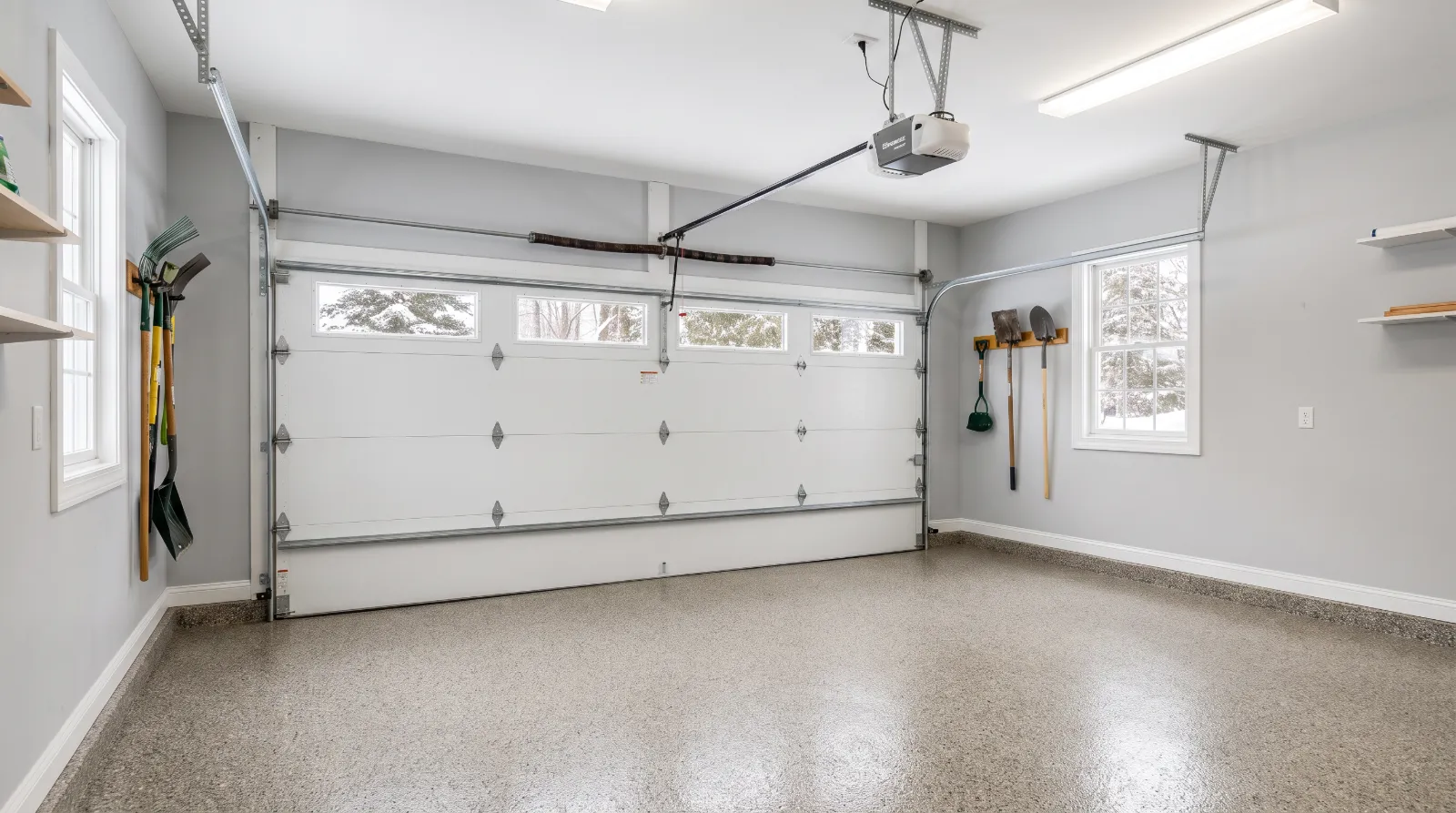
Cranston has every age of garage door. There are 1950s single-car doors on postwar capes in Garden City and Oaklawn, wood doors on detached garages in Edgewood that have been painted a dozen times, and steel two-car doors on Western Cranston homes built in the 1990s and 2000s. The right answer for each is different.
Usually worth repairing
- A broken spring on a door that's otherwise solid. This is the most common repair there is. See our spring guide.
- A cable off its drum or a roller out of the track, without a bent or cracked section.
- Worn rollers, hinges or a bottom seal. Normal wear parts.
- An opener problem. The opener can be repaired or replaced on its own without touching the door.
- One damaged section on a door whose model is still made, so a matching panel can be ordered.
Signs it may be time to replace
- Rust-through along the bottom section or the seams of a steel door, common near the bay.
- Rot or splitting in a wood door, especially along the bottom where water and slush sit.
- Several sections cracked or bent, or a section that's folded after being hit.
- Several big repairs at once: springs, cables, rollers, brackets and a seal all worn out together.
- No replacement panels made for your door anymore.
- A very heavy old door that keeps wearing out springs and openers.
- Safety concerns, like an old door with pinch-prone panel joints or extension springs with no safety cables.
Not sure which side of the line your door is on? A technician can tell you on site.
Call (401) 498-DOORQuestions to ask before deciding
- What's actually wrong, and what else is close to failing?
- Is the door's model still made, so sections are available?
- How much life is left in the springs, cables and rollers?
- Would a new door change anything else, like insulation for a heated garage or a quieter opener?
- How long would each option take, and what's covered afterward?
A good company will explain the options and let you decide. If you feel pushed toward a new door when you only called about a spring, it's fine to ask for the repair alone, or to talk to another company. More on that on our questions to ask page.
Things that matter more in Cranston
Coastal air
If you're near the water and your current door rusted out, ask about doors with better corrosion protection, galvanized hardware, and composite or vinyl bottom sections. Our salt air page has more detail.
Older detached garages
Many older detached garages have low headroom, out-of-square openings or jambs softened by moisture. A replacement may need the framing repaired or special low-headroom track. Mention the garage's age and condition when you call.
Shared driveways
In parts of Edgewood, Knightsville and Eden Park, neighbors share a driveway. If a new door or opener means a truck and a few hours of work, a heads-up to your neighbor helps.
Winter
A door can be replaced in winter. If your old door is drafty and you heat the garage, or there's a room above it, insulation may be worth asking about.
If you do decide on a new door, our new garage door installation guide covers styles, insulation and older detached garages.
Opener: repair or replace?
That's a separate question. Openers older than about 1993 may not have the safety sensors now required, which is a good reason to replace them. Newer openers with a stripped gear or a failed sensor are usually repairable. See our opener repair page.
Common questions
How long does a garage door last?
A well-kept steel door often lasts 20 to 30 years or more. The springs, cables, rollers and opener wear out much sooner and get replaced along the way. Doors near the water may rust out sooner.
Can I replace just one panel of my garage door?
Sometimes, if the manufacturer still makes that model and finish. Older doors often have no matching panels available, and a mismatched section can look out of place.
Will a new door fix my opener problems?
It can, if the old door was heavy, unbalanced or binding. But if the opener itself is failing, it may need repair or replacement too. A technician can test both.