A garage door that won't move is one of the most common calls in Cranston, and it happens at the worst times: a dark January morning when you need the car, or a summer evening when the door won't close behind you. The good news is that the cause is usually one of a short list. The bad news is that two of the causes involve parts you shouldn't touch.
Stop first if: you heard a loud bang, the door is crooked, a cable is hanging loose, or the door feels much heavier than normal. Those point to a broken spring or cable. Don't keep pressing the button and don't try to lift the door by hand.
If the door won't open
1. Nothing happens at all
No light on the opener, no hum, no click. Start with power. Openers are usually plugged into a ceiling outlet, and in many Cranston garages that outlet shares a GFCI with the outside outlets or a basement circuit. Look for a tripped GFCI with a reset button, then check the breaker panel. Older detached garages in Edgewood and Knightsville sometimes run off a single circuit from the house that trips when someone runs a space heater or a shop vac.
If the opener has power, check the wall control. Most have a lock or vacation button that disables the remotes. It's easy to press by accident with a shoulder or a bag of groceries.
2. The remote doesn't work but the wall button does
That's almost always the remote: a dead battery, or a remote that lost its pairing after a power outage. Try a fresh battery first. If the outside keypad also stopped working at the same time, the opener's receiver or antenna may be the issue, which is an opener repair question.
3. The motor runs but the door doesn't move
Listen to it. A motor that runs smoothly while the chain or belt doesn't move usually means a stripped drive gear inside the opener. A chain or belt that moves while the door stays put means the trolley is disconnected from the door, often because someone pulled the red release cord. Reconnecting the trolley is normally a simple job, but only if the springs are intact. If the door feels heavy when the trolley is disconnected, don't reconnect it and run the opener. Call instead.
4. The motor hums, the door lifts a few inches and stops
This is the classic broken spring pattern. The springs do almost all of the lifting, and the opener only guides the door. When a spring breaks, the opener tries to lift a door that can weigh a couple of hundred pounds, strains, and its force setting shuts it off. Look up at the spring above the door. A gap of a couple of inches in the coils means it's broken. Our broken spring guide explains what happens next.
5. The door is frozen to the floor
Common after a nor'easter, when meltwater runs under the door and freezes overnight. The opener strains and the door won't budge, or it lifts on one side. Free the bottom seal before you try again: a plastic scraper along the seal, or a hair dryer on low. Don't chip at it with a metal shovel, which tears the rubber. The winter prep guide covers how to stop it happening again.
If the door won't close, or goes back up
6. Safety sensors
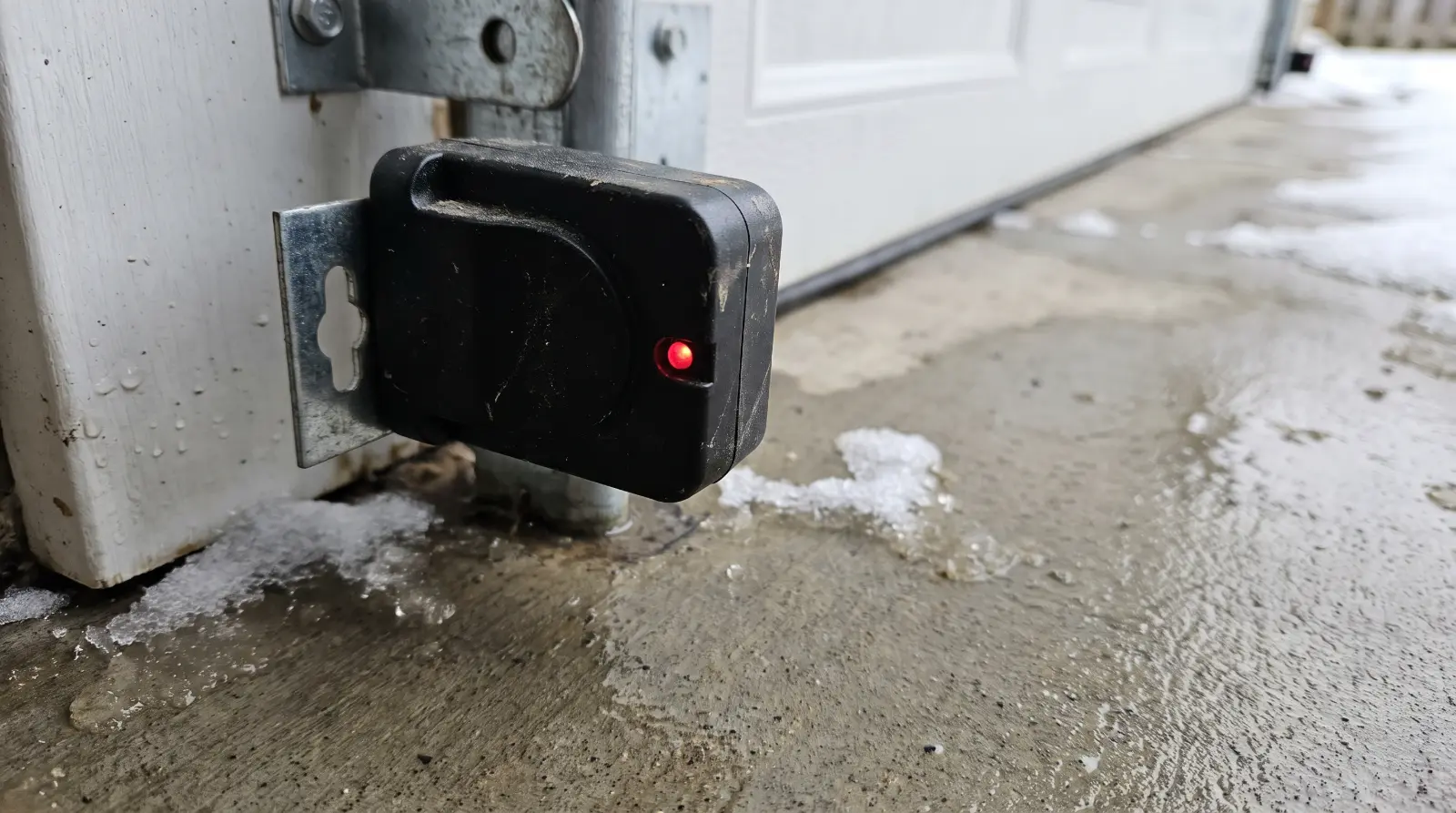
Federal rules require openers to have a pair of photo-eye sensors near the floor. If the beam between them is blocked or the sensors can't see each other, the door won't close, or it starts down and reverses. In Cranston the usual culprits are:
- Lenses fogged with condensation on humid summer days, or coated in road grime and salt spray from cars in winter
- A sensor knocked out of line by a recycling bin, bike or lawn mower
- Bright low sun shining straight into one sensor in late afternoon
- Something in the doorway you didn't notice, like a broom handle or a hose
Wipe both lenses with a soft dry cloth. Look at the small lights on each sensor. Most brands show a steady light on both when they're lined up, and a blinking or dark light on one when they aren't. Gently turn the misaligned one until its light comes on steady. As a temporary measure, holding the wall button down until the door closes fully will override the sensors on most openers. Watch the door the whole time.
7. The door closes, hits the floor and goes back up
If the sensors are fine, the opener may think it's hitting an obstacle. Ice or a pile of slush under the door can do it. So can a close limit that's set wrong, which sometimes drifts after a few seasons of temperature swings. Adjusting limits is in the owner's manual for most openers. If the door also looks uneven or a cable seems slack, leave the settings alone, because the problem is the door, not the opener.
8. The door is crooked or off track
One side lower than the other, a roller sitting outside the track, or a cable dangling: stop using the door. One side has lost support, and running the opener can twist the door or pull it out of the opening. This is cable and track work for a technician.
Checked the simple stuff and it still won't move? Call and describe what you see.
Call (401) 498-DOORWhat to tell the company when you call
You'll get a more useful answer faster if you can describe the door in a few words. Have these ready:
- What happens when you press the button: nothing, a hum, a click, a few inches and stop, or up and back down
- Whether you heard a bang, and roughly when
- Whether your car is stuck inside
- One spring above the door or two, or long springs running along the sides
- The opener brand if you can see it, and roughly how old it is
Our page on what to ask a garage door company has a longer list, including how to check a contractor's Rhode Island registration.
Common questions
Why does my garage door open but not close?
Almost always the safety sensors near the floor. Either something is blocking the beam, a lens is dirty or fogged, or one sensor got bumped out of line. Clean both lenses and check that both lights are steady.
Can I open the door by hand if the opener isn't working?
Only if the springs are intact. With the door fully closed, pulling the red release cord lets you lift it by hand, and a healthy door should feel fairly light. If it feels very heavy, a spring is probably broken, so lower it and leave it closed. Never pull the release cord while the door is open, because it can drop.
My door stopped working after a power outage. What happened?
Many openers lose their remote pairing or need a reset after an outage. A power surge can also damage the opener's circuit board. Try the wall button first, then reprogram the remote using the opener's learn button. If the wall button does nothing either, the opener may need repair.
How long does a typical repair take?
Sensor, limit and remote problems are usually quick once a technician is there. Spring and cable repairs commonly take an hour or two. A new opener installation is often a few hours. The company you speak with can give you a better idea for your door.